ABOUT

Yellow-eared Parrot Habitat Protection

Status:
Past
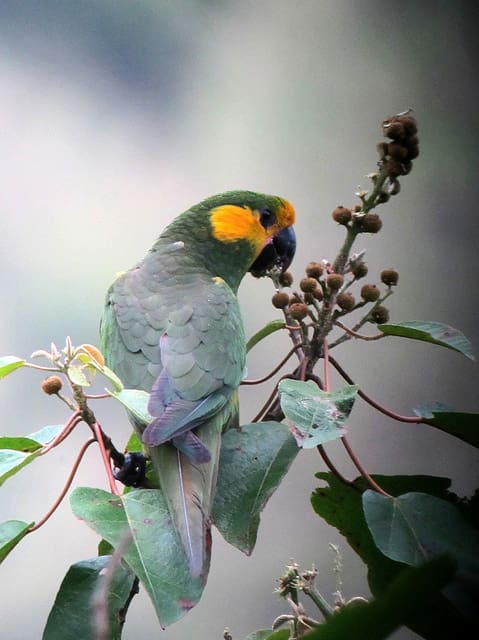
A wild Yellow-eared Conure feeds on berries
© Felix Uribe [CC BY-NC 2.0] via Flickr
Collaborators/Funders:

Proyecto Ognorhynchus (ProAves Colombia), Conservation International, World Land Trust, World Land Trust-USA

View Species Profile

The Yellow-eared Parrot (Ognorhynchus icterotis) has been impacted by loss of habitat. It has lost over 90% of its habitat in Colombia alone.

WPT joined the American Bird Conservancy (ABC) to fund researching Yellow-eared Parrot ecology, carryiing out surveys, actively protecting habitat and educating local communities.

In the mid-1990s, World Parrot Trust, American Bird Conservancy, The World Land Trust, World Land Trust-USA and others funded Proyecto Ognorhynchus, of ProAves Colombia, aiding fieldwork, helping purchase crucial habitat in Ecuador, and supporting education and involvement of local people in the preservation of the Yellow-eared Parrot. Intensive conservation efforts had brought the population up to 2600 individuals by 2019.

Status: IUCN Endangered / CITES Appendix I

Population: 1000 mature individuals, increasing.

Threats: This parrot suffered a severe population collapse due to the near-total loss of its important wax palm tree. Its status in Ecuador is unclear but precarious; it may now be extinct there. Colonial nesting behaviour could make it vulnerable to trapping.

Range: Yellow-eared Parrots are found in the Andean highlands in NW Ecuador, north from Pichincha and W Cotopaxi, and W Colombia, north to Antioquia and NW Norte de Santander. Recently found only from degraded localities in Cordillera Central, Colombia, and W Cotopaxi, Ecuador.

Natural history:  The Yellow-eared Parrot prefers areas with Ceroxylon wax palm trees in upland humid mountain forest and will tolerate only partially cleared areas, so important is the wax palm in its overall ecology.  They reportedly feed on Ceroxylon quindiuense and C. alpinum, and possibly fruit from other species in this genus, and fruits of Sanurania and Sapium spp.  These birds are active at dawn feeding in small flocks, or during the breeding season, in pairs. Larger numbers are found when the birds return to roost in mid-afternoon.
Join Our Flock

FlockTalk our monthly newsletter for parrot people everywhere:

+ News from the world of parrots

+ Updates on wild parrot projects

+ Inspiring updates from partners

+ Real stories from the parrot flock

+ Plus, expert tips for caring for your feathered friends at home.


Stay In The Loop, Sign Up Now.

FlockTalk: our monthly newsletter for parrot people everywhere:

Parrot news. Conservation wins. Pet care tips. All in one monthly email.

We do not sell or share your information with anyone.