Status:
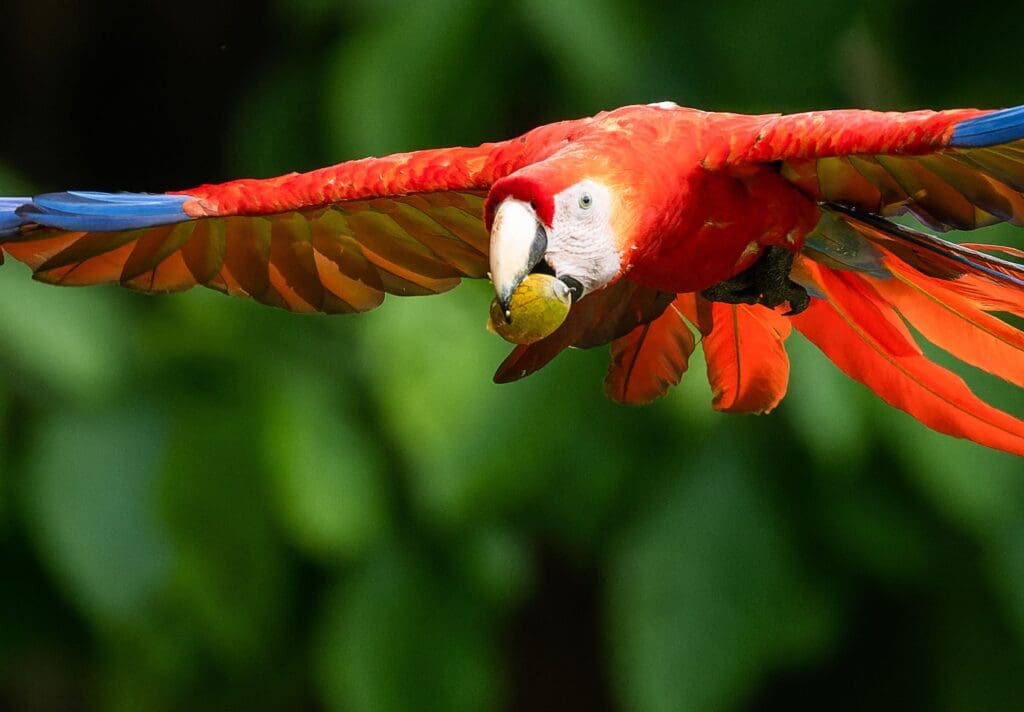 Photo: © Corey Raffel
 Collaborators/Funders:
Paradise Park UK, Asociación Copán, Natural Encounters Conservation Fund (NECF), Macaw Mountain Bird Park and Nature Reserve (PRO-ALAS), Wild Sun Rescue

Scarlet Macaws are threatened by illegal harvesting for the wild bird trade, hunting and habitat loss. In Middle America, subspecies cyanopterus now survives only in the Lacandón Forest, Mexico, is confined to one area in Belize, is extinct in most of Guatemala and also in El Salvador, and is nearly gone from the Pacific slope of Honduras and Nicaragua. On the Caribbean side, perhaps 1000–1500 birds survive in Honduras and a population persists in E Nicaragua. Nominate macao has also suffered substantial declines in settled and developing areas.
Since the mid-1990s, WPT and Natural Encounters Conservation Fund (NECF) have financially supported direct conservation, education programs, captive breeding and release, and rehabilitation and release of birds caught in the trade with partners in Mexico and Honduras. PRO-ALAS (Macaw Mountain Bird Park and Nature Reserve) in Honduras conducts releases at the Park and elsewhere. Their “Patrulla Con Alas” (Winged Agents) project involves children from local communities in Honduras acting as guardians and birding guides for Scarlet Macaws and other wildlife.
In a project funded by WPT and NECF, Wild Sun Rescue in Costa Rica assesses natural nesting cavities in the southern Nicoya Peninsula. The team found 20 suitable sites to place nest boxes for the macaws. Since 2019, with their local partners at AsoProapa, the team has released 35 Scarlet Macaws in the area. The nest boxes will help provide them with nesting sites to begin breeding. To engage the public in monitoring and protecting the macaws the team has produced and distributed an information pamphlet for educational purposes.
In 2024, WPT supported the initial planning stages for a new release program in Gracias, Lempira. PRO-ALAS staff conducted several critical organisational visits to establish local partnerships and set the groundwork for a successful release program in the coming months.
Status: IUCN Least Concern / CITES Appendix I
Population: 50,000-500,000 individuals, decreasing.
Threats: In many parts of its range the species is declining or locally extinct as a consequence of trapping pressure and habitat loss, with forest being lost at a rate of 9% over three generations. The impact of trapping has not been quantified but is assumed to be substantial given the macaws’ popularity as companion animals.
Range: A. m. macao: Costa Rica on Pacific slope; S Panama, on Azuero Peninsula and Isla Coiba, then scattered through N South America, east of Andes, from Rio Magdalena valley, Colombia to Guianas and south to E Ecuador, E Peru, E Bolivia and N Mato Grosso, Brazil.
A.m. cyanoptera: Oaxaca and S Tamaulipas, SE Mexico, scattered to NE Nicaragua.
Natural history: The Scarlet Macaw is found in lowland rainforest and savanna, in Mexico, remote portions of humid forest, on the Pacific slope in Honduras, in Costa Rica, deciduous and humid forest, Colombia in lowland rainforest and gallery forest and in Venezuela, rainforest and savanna. The macaws are encountered in pairs, parties of 3-4 or flocks of 30 individuals as they forage on fruits, fruits and nuts of various palms, and seeds, flowers and nectar.