Red-and-blue Lories: Rescue and Rehabilitation from Trade
Status:
Collaborators/Funders:
Pusat Informasi Sampiri (PIS), Tasikoki Wildlife Rescue Center (Tasikoki WRC), North Sulawesi Provincial Department for Conservation of Natural Resources (BKSDA), Marine and Local Police, and other law enforcement.
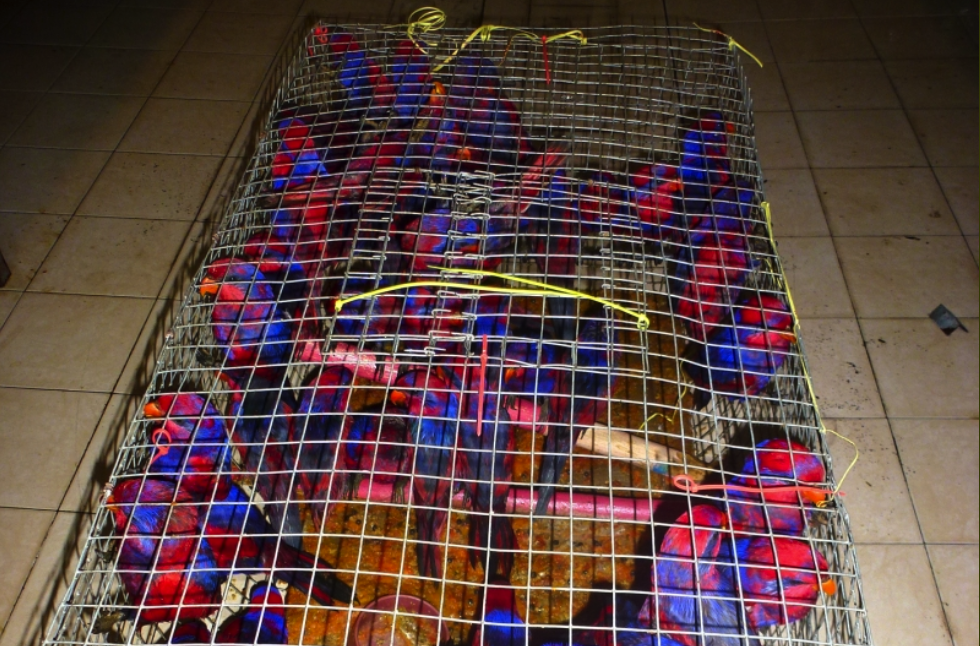
Illegal trafficking has greatly diminished wild Red-and-blue Lory populations. World Parrot Trust is working with in-country colleagues and partners such as the North Sulawesi Provincial Department for Conservation of Natural Resources (BKSDA), Marine Police, Local Police, Tasikoki Wildlife Rescue Centre (TWRC) and Pusat Informasi Sampiri (PIS) to help stop trafficking. A multi-faceted strategy aims to stop the initial movement of birds off the islands and curb onward travel for birds intercepted at the port in Manado, a main shipping hub. Confiscated birds, usually smuggled in plastic bottles, need immediate veterinary attention and are triaged at holding aviaries. This approach streamlines their release, eliminating the need for prolonged quarantine at Tasikoki WRC to speed up their return to the wild. To track potential recurrence of trapping, birds intercepted from trade are ringed for identification. In the second phase of the project, WPT’s team plans to include international ports in the Philippines, which will address the global trade of this species.
A total of 137 Red-and-blue Lories were confiscated and received by official facilities In North Sulawesi from 2021 to 2024. This includes recent spikes of 93 birds in 2023 and continued seizures in 2024. Birds at Tasikoki in 2025 are to be transferred to a captive breeding facility, the Prigen Conservation Breeding Ark in Java.
WPT supports the release and reintroduction of Red-and-blue Lories with partner TWRC, with the backing of the BKSDA. The aim is to release birds caught in trade to lay the groundwork for the species’ resurgence on islands where it has gone extinct. WPT will train staff at the centre on appropriate release management, disease testing and health and body condition assessments for the birds. The soft release process allows the birds to habituate to their surroundings before release. While under Tasikoki’s care, they are also being acclimatised to artificial nests to increase their chances of successfully breeding post-release. Addressing ongoing seizures is essential in conserving Red-and-blue Lories given their IUCN-Endangered status and continued capture for trade.
IUCN/CITES Status: Endangered / Appendix I
Population: 2400-8400 mature individuals, rapidly decreasing. Nominate of species possibly extinct on Sangihe.
Threats: This species has a restricted range. Habitat loss and overexploitation for trade have caused serious declines. Other potential threats include use of pesticides and disease transmission from captive to wild birds.
Range: Native to Sangihe, Talaud and Nanusa Islands, Indonesia. Nominate on Sangihe likely extinct.
Natural history: Red-and-blue Lories are found in forest and cultivated areas up to 1250 m (4100 ft). Their diet includes coconut, and the fruit and nectar of various trees. Insects are also taken. They are most commonly seen flying in groups of up to 8 birds. Large, very vocal numbers gather together to roost.