Puerto Rican Amazons: Habitat Protection and Restoration
Status:
Collaborators/Funders:
United States Forest Service (USFS)
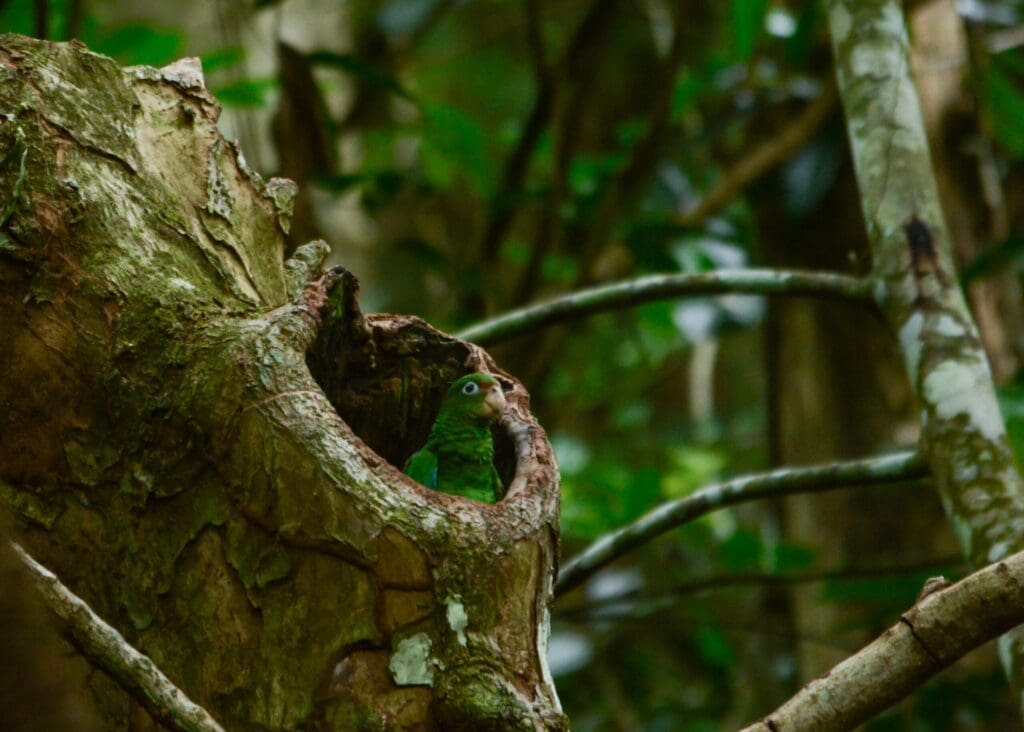
Puerto Rican Amazons (Amazona vittata) are critically endangered in the wild due to habitat destruction. They are now confined to 0.2% of their former range.
The partnership between World Parrot Trust (WPT) and the United States Forest Service (USFS) focuses on the strategic improvement and maintenance of habitats crucial for the recovery of the Puerto Rican Amazon. These efforts aim to mitigate the impacts of hurricanes and other environmental challenges. The team employs strategic habitat planning for habitat restoration by anticipating the future movements and dispersion of the parrots. They plant trees, encourage natural regeneration, collect native seeds and seedlings for propagation and work to control erosion and invasive plant species. To ensure successful breeding, nest boxes are built, installed and maintained in current and future habitats. Monitoring these nests helps us understand their use and success, allowing for adjustments as needed.
Continuous monitoring of wild parrot populations is done in conjunction with studies on habitat use, movement, foraging, and nest use. This data informs ongoing and future conservation strategies. The team engages in extensive planting activities, including tree propagation in greenhouses to ensure a steady supply of native species for habitat enhancement. Soil erosion control is also important, as is invasive species management. Working with local landowners in key areas, the team ensures widespread coordinated efforts towards landscape-scale habitat protection and reforestation.
The combined efforts of WPT and USFS aim to create a resilient habitat that can support a thriving population of Puerto Rican Amazons, ensuring their survival and recovery in the wild. This collaborative approach addresses immediate conservation needs and builds a sustainable framework for future ecological stability.
IUCN/CITES Status: Critically Endangered / Appendix I
Population: About 1000 individuals, wild and in a breeding program.
Threats: This parrot has a restricted range. Is affected mainly by habitat loss, hunting, trapping and increasingly severe hurricanes. In addition, introduced honeybees occupy nest cavities, botflies parasitise nestlings and Pearly-eyed Thrashers destroy nests.
Range: Puerto Rico and formerly neighbouring islands of Mona and Culebra.
Natural history: This species was formerly found in all vegetation types from mangrove to montane forest and dry forest to the south of Puerto Rico. The remnant population is between 200-600 metres in moist montane forest. These parrots take seeds, fruits, flowers and leaves from nearly 60 plant species. Breeding in the wild is from February-June in tree cavities.