LEARN

Black-winged Parrot

( Hapalopsittaca melanotis )

Also known as:
Black-eared Parrot, Peruvian Black-winged Parrot (H.m. peruviana)

Also known as:
Black-eared Parrot, Peruvian Black-winged Parrot (H.m. peruviana)

Geography:

DID YOU KNOW?

The members of the Hapalopsittaca genus are among the least known parrots.

<p><em>Hapalopsittaca</em></p>
Genus:

Hapalopsittaca

<p><em>melanotis</em></p>
Species:

melanotis

Size:

24 cm (9.4 in)

Weight:

Probably 125 g (4.4 oz)

Subspecies including nominate:

two: H.m. melanotis, H.m. peruviana

Colour Adult:

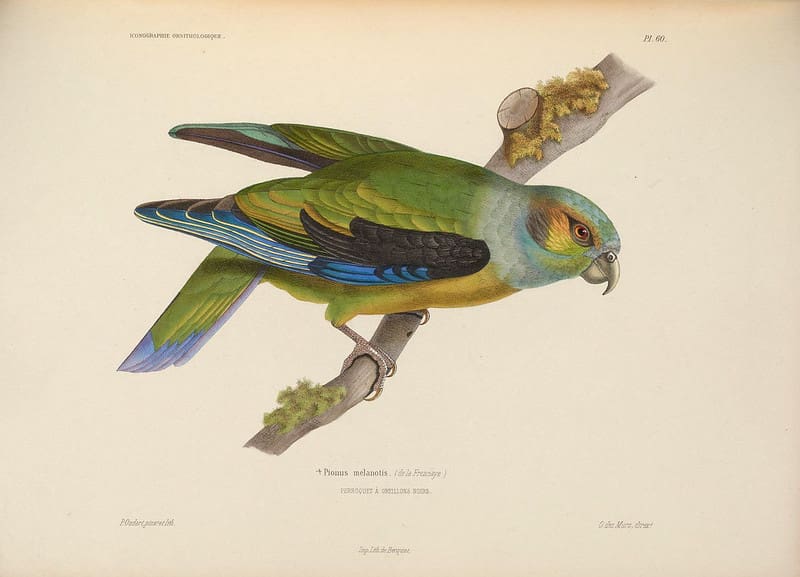
H.m. melanotis: Both adults mostly green; blue lores and frontal band; blue wash on crown and neck, with blue collar on area of neck; black ear coverts; black upper wing coverts and outermost secondaries; black inner secondaries edged with green on outer webs; green tail tipped with purple/blue. Beak blue/grey with horn coloured tip. Eye brown.
H.m. peruviana: Both adults brown/orange ear coverts; blue wash on foreneck restricted to thin band on throat.

Colour Juvenile:

H.m. melanotis: Black upper wing coverts, widely edged with green.

Call:

Calls made in flight are rapid and repetitious notes.

Xeno-canto Wildlife Sounds-Black-winged Parrot

More Information:

Avibase

Captive Status:

Rare in aviculture.

Longevity:

Housing:

Diet:

Enrichment:

Nest Box Size:

Clutch Size:

Not recorded.

Fledging Age:

Hatch Weight:

Peak Weight:

Weaning Weight:

World Population:

Unknown but described as rare and patchily distributed. Decreasing.

IUCN Red List Status:
Least Concern

CITES Listing:
Appendix II

Threat Summary:

Not globally threatened. A BirdLife “restricted-range” species. This species is considered to have a medium dependency on forest habitat, and tree cover is estimated to have declined by 2.9% within its mapped range over the past three generations. As a precautionary measure, it is tentatively suspected that this deforestation may have led to a 1-19% decline in the species’ population over the same time frame.

Range:

H.m. melanotis:  CW Bolivia (S La Paz to W Santa Cruz).
H.m. peruviana: Central to south Peru (Huánuco to Junín, N Cuzco).

Habitat:

Found up to 1500-3500 m (4920-11,480 ft) in humid montane and cloud forest in the upper subtropical and temperate zones, in tall forest and into boggy elfin growth, where there are fruiting trees.

Wild Diet:

Feeds on berries in forest canopy, with a strong preference for Gaiadendron sp. mistletoe.

Ecology and Behaviour:

Social, seen in pairs or small groups; occasionally in large flocks. Some seasonal movements in response to abundance of food. Keeps mainly to upper stages of canopy where difficult to detect amongst foliage.

Clutch and Egg Size:

Not recorded.

Breeding Season:

Not recorded.

Related Links:

Peru Aves

Join Our Flock

FlockTalk our monthly newsletter for parrot people everywhere:

+ News from the world of parrots

+ Updates on wild parrot projects

+ Inspiring updates from partners

+ Real stories from the parrot flock

+ Plus, expert tips for caring for your feathered friends at home.


Stay In The Loop, Sign Up Now.
FlockTalk: our monthly newsletter for parrot people everywhere:

Parrot news. Conservation wins. Pet care tips. All in one monthly email.

We do not sell or share your information with anyone.