LEARN

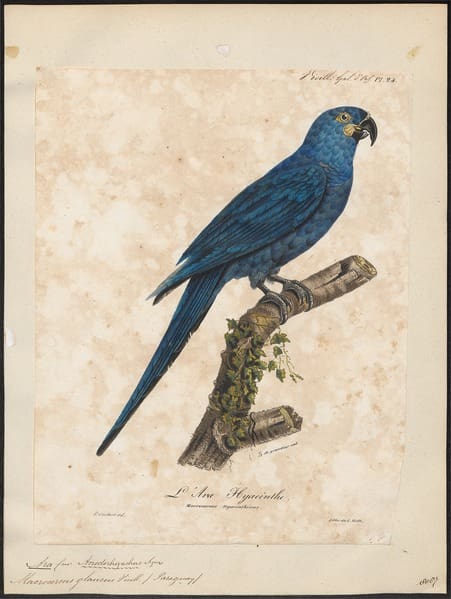
Glaucous Macaw

( Anodorhynchus glaucus )

Geography:

DID YOU KNOW?

There have been only two reliable reports in the 20th century of the Glaucous Macaw in the wild – one direct observation in Uruguay in 1951 and one based on local reports in Parana in the early 1960s.

<p><em>Anodorhynchus</em></p>
Genus:

Anodorhynchus

<p><em>glaucus</em></p>
Species:

glaucus

Size:

72 cm (28.1 in)

Weight:

Not recorded.

Subspecies including nominate:

one

Colour Adult:

Both adults green/blue, more green on underparts; grey/green tinge on head and neck; dark grey/brown throat, turning to wash on cheeks and upper breast. Beak grey/black. Eye ring bare and yellow, with paler yellow tear-drop shaped lappet at sides of lower mandible. Eye brown.

Colour Juvenile:

Not recorded.

Call:

Not recorded.

Content Sources:

CITES
Avibase
BirdLife International
Cornell Lab of Ornithology/Birds of the World
A Guide to Parrots of the World, Juniper and Parr, 1998
Parrots of the World, Forshaw, 2006. 2010 edition
Vanished and Vanishing Parrots, Forshaw, 2017.
Lexicon of Parrots, Thomas Arndt.

Captive Status:

Last specimen in captivity died in a Buenos Aries zoo in 1938.

Longevity:

Housing:

Diet:

Enrichment:

Nest Box Size:

Clutch Size:

Not recorded.

Fledging Age:

Hatch Weight:

Peak Weight:

Weaning Weight:

World Population:

Unknown. Became rare by the early second half of the 19th century; there have been few reports from the 20th century. The last likely observations of the species were from Mbaracayu, Paraguay in the late 1990s and 2001. If a population remains it is likely extremely small.

IUCN Red List Status:
Critically Endangered

CITES Listing:
Appendix I

Possibly Extinct (PE)

Threat Summary:

Habitat degradation and destruction due to settlement of the major river basins. Was also hunted and captured for the wild bird trade.

Range:

Was formerly found in southeastern Brazil, western Uruguay and northern Argentina. Evidence that the species occurred in Paraguay is no longer considered valid. Most records are distributed along the middle reaches of major rivers—the Uruguay, Paraná and Paraguay—and adjacent areas, especially in Corrientes province, Argentina. However, current reviews suggest that the species’ distribution may have been much wider, extending as far east as coastal Santa Catarina (Brazil) and possibly further northeast.

Habitat:

Is thought to have been lightly wooded grassland, marshes and river borders with good stands of palms and in particular yatay or chatay (Butia yatay). A review of historical sources suggests that the species may have also inhabited grasslands and savannas.

Wild Diet:

Thought to have fed on the nuts of Butia yatay palms.

Ecology and Behaviour:

Likely gregarious.

Clutch and Egg Size:

Not recorded.

Breeding Season:

Not recorded.

Related Links:

Join Our Flock

FlockTalk our monthly newsletter for parrot people everywhere:

+ News from the world of parrots

+ Updates on wild parrot projects

+ Inspiring updates from partners

+ Real stories from the parrot flock

+ Plus, expert tips for caring for your feathered friends at home.


Stay In The Loop, Sign Up Now.
FlockTalk: our monthly newsletter for parrot people everywhere:

Parrot news. Conservation wins. Pet care tips. All in one monthly email.

We do not sell or share your information with anyone.