LEARN

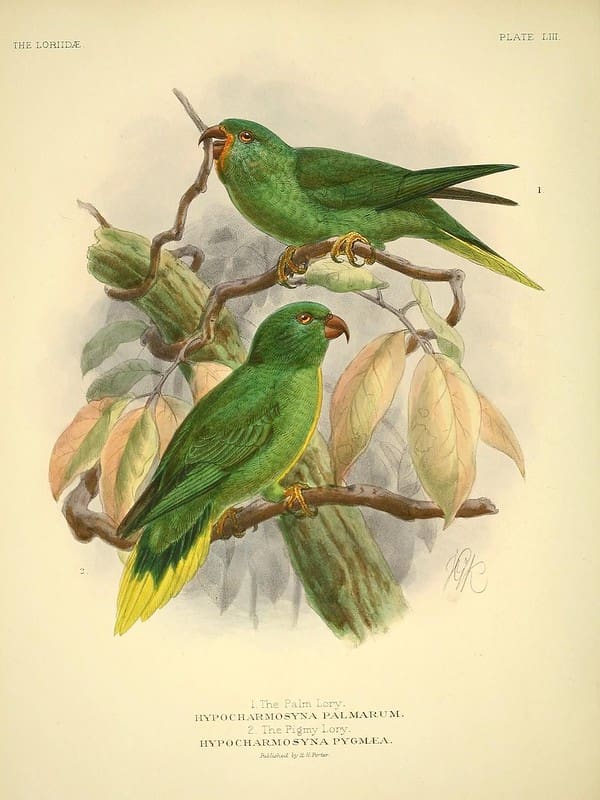
Palm Lorikeet

( Vini palmarum )

Also known as:
Green Palm Lorikeet, Vanuatu Lorikeet

Also known as:
Green Palm Lorikeet, Vanuatu Lorikeet

Geography:

DID YOU KNOW?

These parrots are virtually undetectable because of their resemblance to the surrounding foliage. They are only found by their occasional high, shrill calls.

<p><em>Vini</em></p>
Genus:

Vini

<p><em>palmarum</em></p>
Species:

palmarum

Size:

17 cm (6.6 in)

Weight:

35 g (1.2 oz)

Subspecies including nominate:

one

Colour Adult:

Both adults red on chin, lores, and base of bill (less in female); mantle washed with olive/brown, often missing in female; underwing band absent; green tail with wide yellow tip; orange beak; yellow eye.

Colour Juvenile:

As in female but with orange/brown beak and brown/yellow eye.

Call:

Calls are short and high-pitched; more rapid when given in flight.  Shrill twittering heard when bird is feeding and softer notes given while at rest.

Xeno-canto Wildlife Sounds -Palm Lorikeet

More Information:

Avibase

Captive Status:

Not found in aviculture.

Longevity:

Housing:

Enclosure, easily cleaned, 2.5 x 1 x 2 m (8 x 3 x 6 ft). Minimum temperature 20 C (68 F), not less than 24 C (75 F) during acclimatisation.

Diet:

Lory nectar of thin porridge, honey, pollen, brewer’s yeast, vitamins and mineral supplements or commercial nectar; different fruits such as pear, peach, passion fruit and apple; greenfood such as kale and dandelion; different wild edible berries (rowan, pyracanthas and rose hips).

Enrichment:

Nest Box Size:

Box 20 x 20 x 40 cm (10 x 10 x 20 in).

Clutch Size:

Probably 2.

Fledging Age:

Hatch Weight:

Peak Weight:

Weaning Weight:

World Population:

5000-20,000 mature individuals, decreasing.

IUCN Red List Status:
Least Concern

CITES Listing:
Appendix II

Threat Summary:

A BirdLife “restricted-range” species. Threats include avian malaria, cyclones and natural cycles. Lowland forest, which may or may not be used by this species, is being cleared for agriculture, timber and commercial logging.

Range:

Santa Cruz, Duff and possibly Reef Islands, easternmost Solomon Islands, and Vanuatu, including Banks Islands.

Habitat:

Found above 1000 m (3280 ft) in undisturbed montane forest, irregularly in lowlands.

Wild Diet:

Feeds on nectar and pollen of various trees, palms, lianas and shrubs, notably from flowers of sago palms (Metroxylon rumphii) and Erythrina; also takes Ficus figs and berries.

Ecology and Behaviour:

Nomadic, traveling widely between feeding sites in pairs and medium-sized flocks. Appears in lowlands sporadically. Pair bonds strong in large flocks.

Clutch and Egg Size:

Possibly 2 eggs.

Breeding Season:

Beginning in October, young in December. Nest is in hollow tree limb or trunk.

Related Links:

Join Our Flock

FlockTalk our monthly newsletter for parrot people everywhere:

+ News from the world of parrots

+ Updates on wild parrot projects

+ Inspiring updates from partners

+ Real stories from the parrot flock

+ Plus, expert tips for caring for your feathered friends at home.


Stay In The Loop, Sign Up Now.
FlockTalk: our monthly newsletter for parrot people everywhere:

Parrot news. Conservation wins. Pet care tips. All in one monthly email.

We do not sell or share your information with anyone.