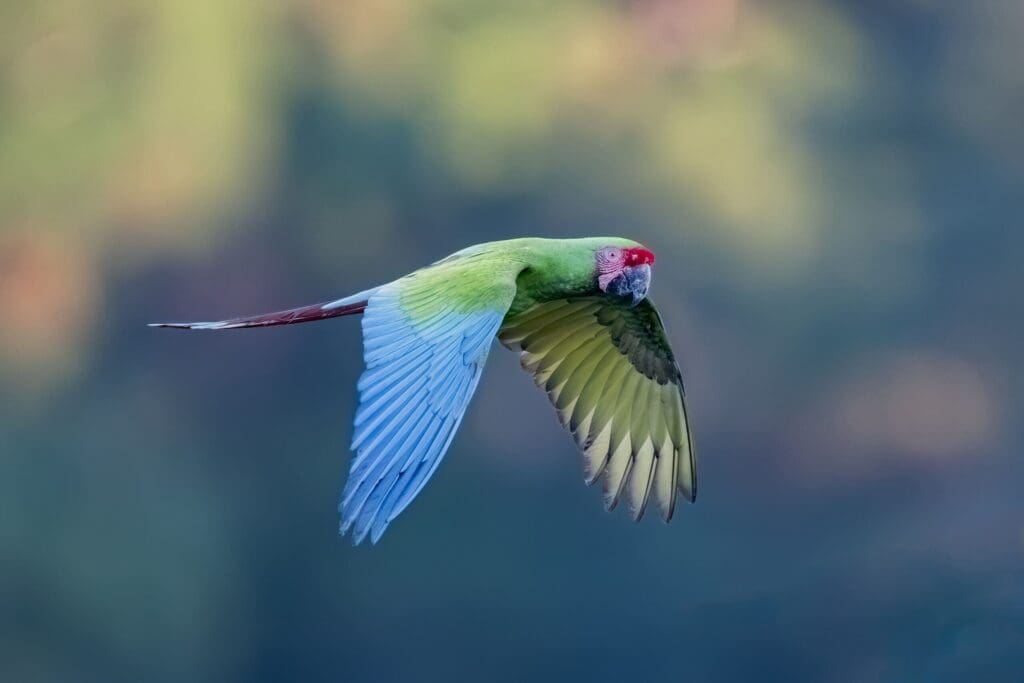
In 2010, WPT partner Ara Manzanillo, then The Ara Project, initiated a Great Green Macaw reintroduction project in the South Caribbean region of Costa Rica. Their objective was to establish a self-sustaining Great Green Macaw population there and have them eventually join with the remaining populations in northern Costa Rica. Among other efforts, the team works to restore key forests, rescues birds injured or caught in illegal trade and installs nest boxes to increase breeding success.
As of the 2022 breeding season, the team installed 20 artificial nests where 50 Great Green Macaw chicks fledged. The 2023 breeding season saw over 60 chicks fledge from artificial nests, with many other juveniles hatched in natural cavities joining the adult population. Ara Manzanillo is restoring a small but growing reintroduced population in the country’s southwest: one hundred and twenty macaws are now flying free and reproducing in the wild. In 2026, WPT established the first range-wide technical training network, delivering the first international Great Green Macaw nest access and monitoring workshop, bringing together more than 25 conservation practitioners from four countries.
Status: IUCN Critically Endangered / CITES Appendix I
Population: 500-1000 mature individuals, decreasing.
Threats: This macaw is extremely sensitive to habitat disturbance. Also hunted for food in some areas and caught for the wild-bird trade.
Range: A.a. ambiguus: Caribbean lowlands of E Honduras to NW Colombia. 
A.a. guayaquilensis: W Ecuador, Esmeraldas; smaller numbers in the Cordillera de Chongon-Colonche, Guayas.
Natural history: The Great Green Macaw is found at altitudes up to 600 m (1968 ft) in Costa Rica and 1000 m (3280 ft) in Panama. It is seen in pairs or small groups foraging on seeds, nuts, fruits, flowers, bulbs, roots and bark. Almendro tree seeds are a major part of the diet. Breeding is May-October in Ecuador, dry season (December-April) in Costa Rica. Nest is in a tree hollow.