ABOUT

Hyacinth Macaw Conservation

Status:
1990s, 2017-current
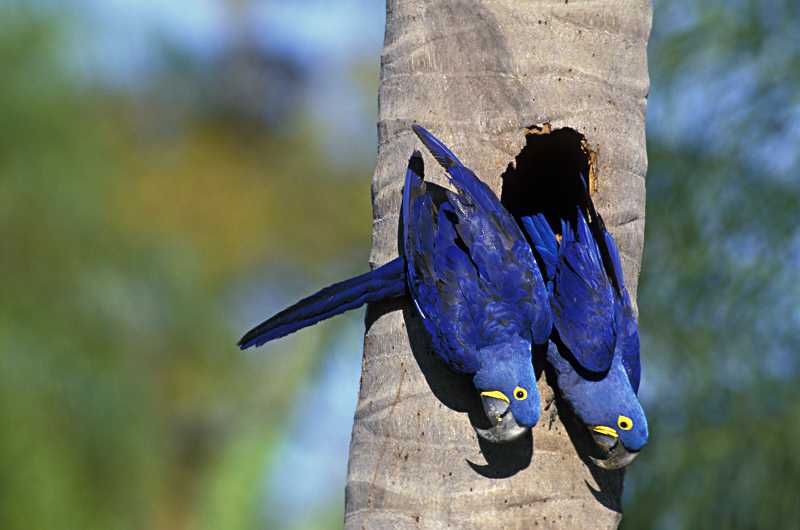
A pair of wild Hyacinth Macaws cling to a palm tree
© Luiz Claudio Marigo
Collaborators/Funders:

Fundación CLB, Phoenix Zoo, Fundación Noel Kempff Mercado, Vogelpark Avifauna, Berlin Zoo, Folke H. Peterson Foundation, Shared Earth Foundation

View Species Profile

Wild Hyacinth Macaw (Anodorhynchus hyacinthinus) populations were reduced to about 3000 birds between 1970 and 1990 when trapping was heaviest, then further affected by hunting and widespread habitat destruction. Currently, five thousand individuals are located in the Pantanal. There have been population declines in E Amazonia and Minas Gerais from an estimated 1500 individuals in 1986 to 1000 in 2003.

The World Parrot Trust began supporting projects that protected remaining populations in 1990, and by 2008, funded studies on the effects of trapping, breeding ecology and other research. The WPT has supported confiscated birds caught in the trade, provided veterinary care, food, and supplies for rescued birds, led work in Bolivia that has focused on monitoring and protecting nest sites, helped provide education and ecotourism opportunities to local communities, and funded research on habitat degradation, population trends, and limitations to breeding success. A fire specialist provided forest fire prevention and response training, as well as equipment, to residents of the area in 2019. Beginning in 2023, Fundación CLB revisited conservation work for the species,  completing a count in Bolivia, the first in many decades. The final total of 300 was added to the range-wide survey conducted in 2025. The team also installed 20 nest boxes to boost breeding success.

Status: IUCN Vulnerable / CITES Appendix I.

Population: 4700-11,000 mature individuals, stable.

Range: Three isolated groups are in central South America: NE Brazil, central E Brazil, S central Brazil to Bolivia and N Paraguay.

Threats: Very heavy trapping for trade (population was reduced to an estimated 3000 birds during the period 1970–1990), some local hunting for food and feathers, and the loss of nest sites to poaching and agriculture. In the Pantanal, only 5% of S. apetala trees have suitable cavities. Young trees are foraged by cattle and burned by frequent fires.

Natural history: These macaws are found in areas rich in nut-bearing trees and shrubs, rocky, steep valleys with deciduous woodland, gallery forest and Mauritia palm swamp; in the Pantanal gallery forest with palm groves. They are seen in pairs, family groups or small flocks. Foods include the nuts of various palms; also fruit and Pomacea molluscs. Breeding is from July to December; nests are in tree cavities in the lower Amazon and Pantanal; in NE Brazil cliff burrows.