ABOUT

Kākā Conservation

Status:
2021 – current
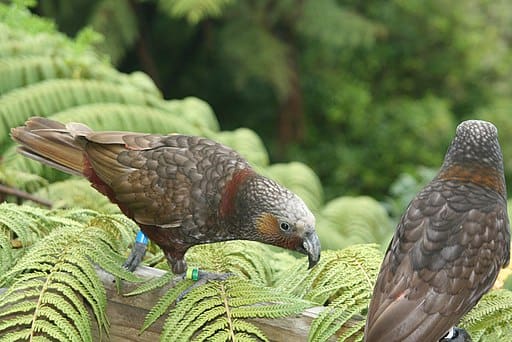
A wild Kākā creeps through vegetation
© Duncan [CC BY-SA 2.0] via Wikimedia Commons
Collaborators/Funders:

The Māori community’s Te Iwi Tahi o Karioi Ahu Whenua Trust, The Cape Sanctuary in Hawke’s Bay, Native Bird Rescue – Waiheke Island, Auckland Zoo, New Zealand Parrot Trust, New Zealand Department of Conservation, Zealandia Sanctuary, Keefe Family Foundation, Te Iwi Tahi o Karioi (TIToK), the Karioi Project, Landcare Research

View Species Profile

Kākā are threatened by predation by introduced species including stoats, which kill females on eggs, and other mammals. Introduced wasps and possums compete with Kākā’s for honeydew, a high-energy resource required by Kākā for successful breeding. A more recent danger faced by Kākā fledglings is window strikes, causing injury or death to many birds each year.

The WPT has collaborated with local and regional partners to support intensified feral predator control, and rehabilitation, release and tracking of injured Kākā on Waiheke Island, a citizen science project assessing the effectiveness of window markers in preventing bird collisions, and with volunteers, radio-tracking captive-bred birds released at Cape Sanctuary to better understand movements and survival.

The birds injured in window strikes are rehabilitated by Native Bird Rescue and then released into the wild. Significantly, the center is up to 25 rescued birds as of 2025, and this number is set to increase because Kākā are breeding more often at this location.

In 2025, the WPT supported the transfer of seven captive-bred Kākā to two sanctuaries to boost the genetic diversity of their populations, and aided the rescue and release of 15 juvenile Kākā injured in window strikes. The WPT also funds science for conservation, helping New Zealand scientists to use satellite tags to track the seasonal movements of Kākā across the landscape.
Status: IUCN Endangered / CITES Appendix II

Population: 2500-10,000 mature individuals, decreasing.

Threats: Is affected by forest clearing and predation of nesting females especially, by stoats, Black rats and Brush-tailed possum.

Range: N.m. meridionalis: South and Stewart Islands and larger offshore islands of New Zealand.
N.m. septentrionalis: North Island and some offshore islands.

Natural history: This species is restricted to unbroken Nothofagus and Podocarpus forest between 450 and 1000 m (1476-3280 ft). It will visit gardens and orchards in winter. Forages for fruits, berries, seeds, flowers, buds, nectar, sap, invertebrates, honeydew from scale insects and larvae. Birds have been recorded feeding in kiwi fruit orchards and on flax flowers. Are quiet and shy.

Join Our Flock

FlockTalk our monthly newsletter for parrot people everywhere:

+ News from the world of parrots

+ Updates on wild parrot projects

+ Inspiring updates from partners

+ Real stories from the parrot flock

+ Plus, expert tips for caring for your feathered friends at home.


Stay In The Loop, Sign Up Now.

FlockTalk: our monthly newsletter for parrot people everywhere:

Parrot news. Conservation wins. Pet care tips. All in one monthly email.

We do not sell or share your information with anyone.