Status: IUCN Near Threatened / Appendix I
Population: 260,000–640,000 mature individuals; subspecies macgillivrayi 3000 individuals. Decreasing.
Threats: This species is inferred to be in decline across its range due to clearing for bauxite mining, changing fire regimes, competition with Sulphur-crested Cockatoos and increasing storm severity/frequency. In New Guinea, where >95% of the world population resides, the chief threats are habitat and nest cavity loss and trapping for the pet trade.
Range: P.a. aterrimus: Misool, in W Papuan Islands and Aru Islands, Indonesia.
P.a. macgillivrayi: S New Guinea between Fly and Balim Rivers, and Cape York Peninsula, N Queensland, Australia, south on the east coast to Princess Charlotte Bay and the west coast to Edward River.
P.a. goliath: W Papuan Islands, except Misool, Indonesia, and C New Guinea from Vogelkop, Irian Jaya, east to SE Papua New Guinea.
P.a. stenolophus: Japen Island in Geelvink Bay, Irian Jaya, and N New Guinea from Mamberamo River east to Collingwood Bay, SE Papua New Guinea.
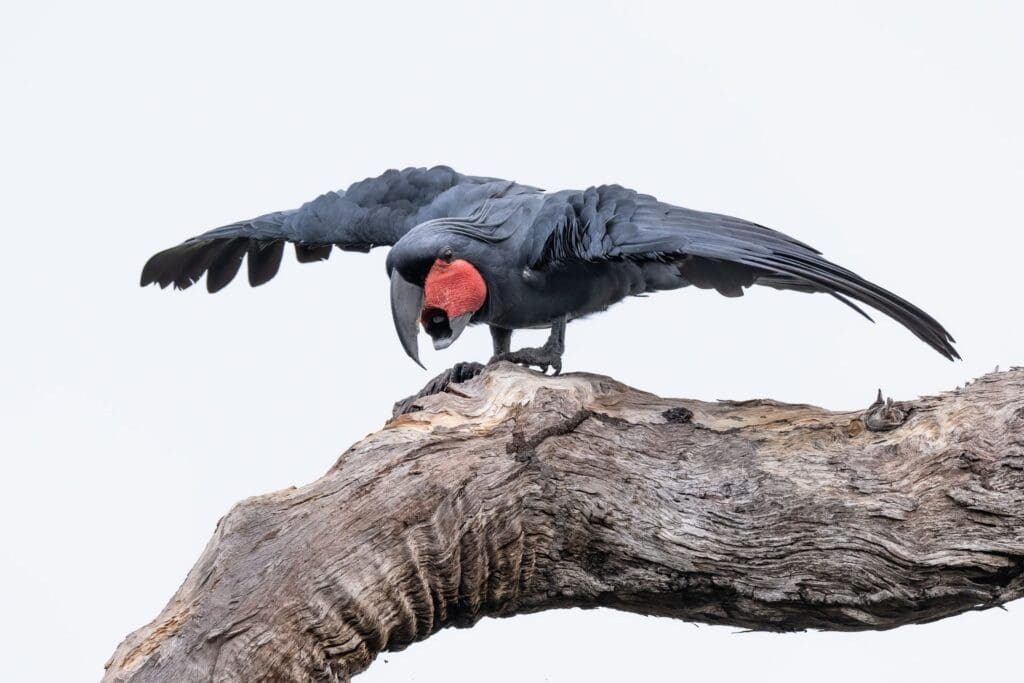
Natural history: The Palm Cockatoo is found in New Guinea and adjacent islands, and N Australia (Queensland) in lowland areas, rainforest, forest edge, monsoon woodland, and tall secondary growth up to 1350 m (4428 ft). It is seen in pairs and small groups and is conspicuous in its behaviour. Birds forage for seeds, nuts, fruits, berries and leaf buds.