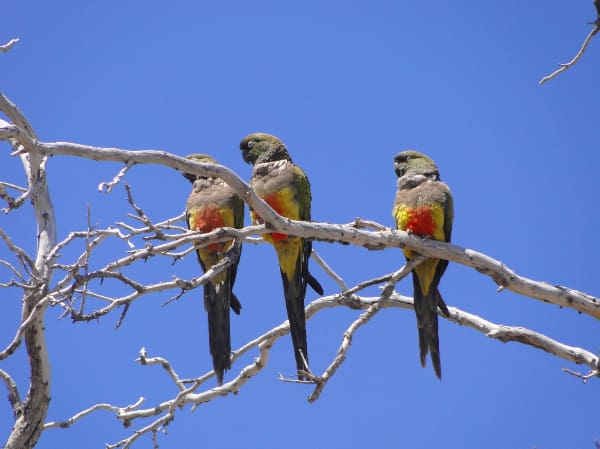
Patagonian Conure (Cyanoliseus patagonus) populations are declining due to ongoing habitat destruction and unsustainable levels of exploitation.
Since 1998, researcher Dr Juan Massello and his team have studied the breeding biology of Patagonian Conures at the species’ largest colony, El Cóndor, in Argentina. Since 2003, WPT has funded research on the birds’ geographic distribution, their conservation status in Argentina and Chile and how ecological and climatic factors influence the population. WPT also supported the protection of nesting colony and other crucial habitat.
In 2004, local organisations and researchers held meetings to coordinate a joint conservation program for El Cóndor. One idea from this congress was to mount an educational campaign for the people and promote ecotourism interests in the region. WPT funded wardens to protect the Cerro Tololo colony in Chile during the breeding season in 2010. As a result, “picos blancos” (white bills or fledged chicks) were seen flying around the colony for the first time in years.
In 2024, after decades of lobbying, the El Cóndor nesting colony was officially protected by the local government. A plan was conceived to support the birds, the local economy and ecotourism.
IUCN/CITES Status: Least Concern / Appendix II
Population: About 95,000 mature individuals, decreasing.
Threats: This species has been heavily trapped for wild bird trade. It is also persecuted as a crop pest and at threat from the destruction of breeding colonies.
Range: C.p. patagonus: S Argentina, ranging north in winter to C Argentina and S Uruguay.
C.p. conlara: C Argentina.
C.p. andinus: NW Argentina, from Salta and Catamarca south to C Mendoza and N San Luis.
C.p. bloxami: formerly C Chile, but now restricted to a few localities in central provinces, including Bio Bio.
Natural history: The Patagonian Conure forms large flocks in its native Argentina and Chile of over 1000 birds, roosting communally in trees, on wires, and in nest tunnels. These gregarious birds are seen in open grass country, savanna, wooded valleys with cliffs and farmland to about 2000 m (6560 ft). They can also be found in arid country near streams and rivers. Their preferred foods include seeds and fruits, and rarely grain crops. A recent study found over 35,000 active nest burrows for the flocks of El Cóndor, Patagonia. The counts showed that the colony extended over 9km of a sandstone cliff facing the ocean.