Tasman Parakeet Conservation
Status:
Collaborators/Funders:
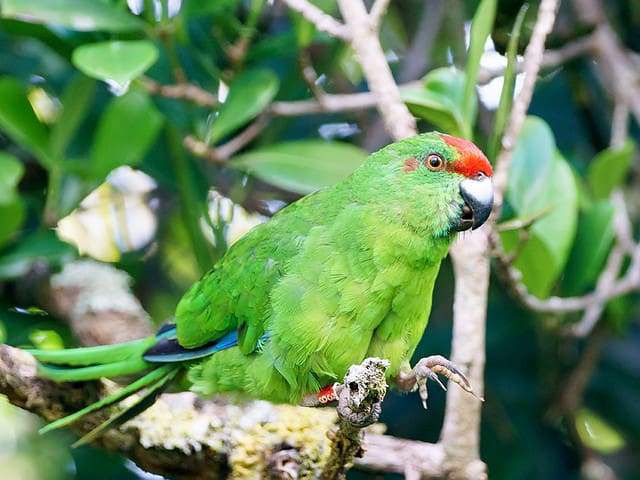
Historically, two subspecies of Tasman Parakeets occurred on Lord Howe and Norfolk Island. Forest clearance combined with the introduction of invasive mammals severely reduced Tasman Parakeet numbers. On Lord Howe Island, hunting to protect fruit crops drove subspecies subfavescens to extinction in the 19th century. Norfolk Island’s nominate persists and is threatened by limited safe nesting cavities and depredation by ship rats and feral cats. The population once numbered 190 pairs but by 1994 had dwindled to only four females and about 30 males. As of 2017, after years of recoveries and declines, the population had recovered to approximately 200-400 birds.
Working with Norfolk Island National Park officials, WPT has provided technical support on pilot radio-tracking studies, population surveys and nest monitoring and protection.
WPT submitted a statement to IUCN regarding the taxonomic treatment of New Zealand parakeets, including Tasman’s Parakeet. Reassigning these birds as separate species could prove positive for their conservation. WPT’s affiliate, New Zealand Parrot Trust, recently supported research uncovering genetic diversity and inbreeding in the Tasman Parakeet population following repeated population bottlenecks, which are events that drastically reduce the size of a population. The data found will have implications for the species’ future management.
Research supported by New Zealand Parrot Trust examined genetic diversity and inbreeding in Tasman Parakeets. The authors discussed the implications of their findings for the future management of Tasman Parakeets, including attempts to translocate an insurance population. The study highlights the importance of considering population genetics in determining appropriate conservation actions for threatened species.
In 2025, findings were published on the effectiveness of predator-proofing nest sites to support Tasman Parakeet breeding, emphasizing the importance of this key conservation and management tool. In addition, WPT is helping the Norfolk Island National Park secure further support to continue introduce predator control on the island.
Status: IUCN Least Concern (as a conspecific of Red-fronted Parakeet) / CITES Appendix I
Population: Fewer than 100 mature individuals, decreasing.
Threats: This parakeet has suffered from the loss of suitable habitat and nest sites. Nest-site availability has been further reduced by competition with introduced Crimson Rosellas and Common Starlings. Black Rats have caused nest failures.
Range: Norfolk Island (between Australia, New Zealand and New Caledonia)
Natural history: The Tasman Parakeet is confined to the Norfolk Island National Park and adjacent forested areas and orchards. Birds take a variety of fruits, shoots, blossoms and shrub seeds. They also feed on introduced olives Olea africana. Breeding is October-December, sometimes more than once a year. The nest is in a burrow or tree cavity.