Yellow-naped Amazons: Field Research
Status:
Collaborators/Funders:
FUNZEL (Fundación Zoológica de El Salvador), Ministry of Environment and Natural Resources (MARN), Green Island Challenge, New Mexico State University, University of Pittsburg at Johnstown
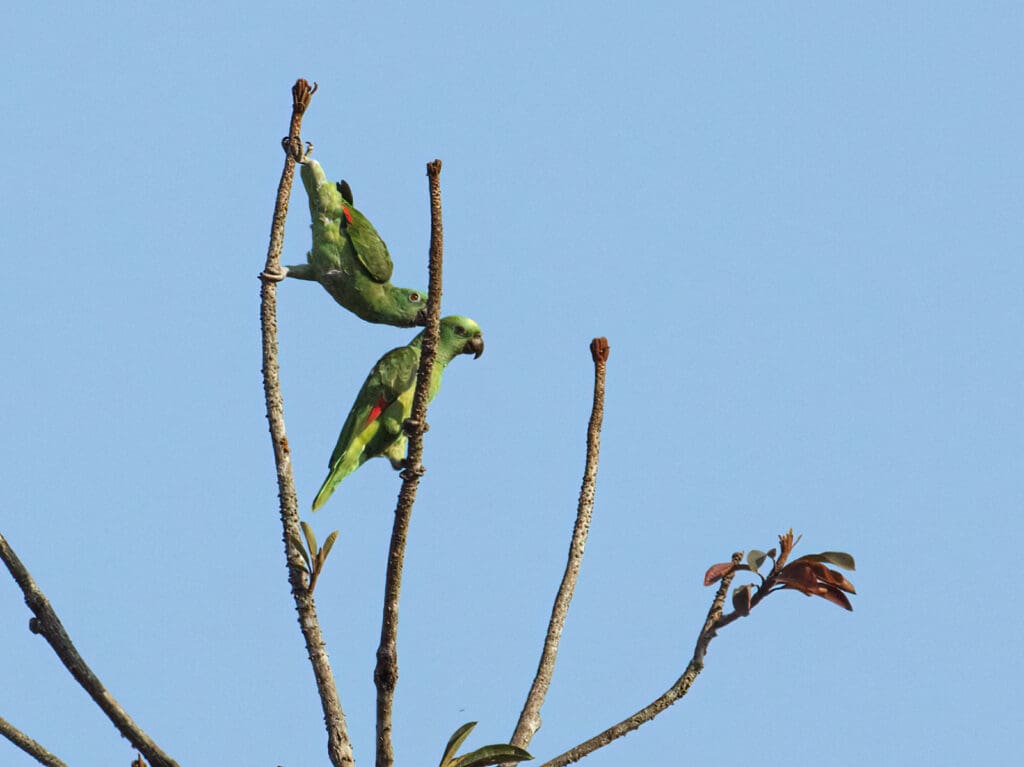
Yellow-naped Amazons are seriously threatened by illegal trapping for trade and ongoing deforestation.
WPT has, since 2007, funded fieldwork and range-wide surveys; studies led to the species being uplisted to IUCN-Critically Endangered. Beginning in 2021, The World Parrot Trust funded research that aimed to uncover Yellow-naped Amazon population trends in the Santa Rosa region of Costa Rica. Four hundred and twenty hours of nest surveys in February-May and roost counts from June to July found a couple hundred birds at one site, with other new roosts also being discovered.
Despite this, the population in Costa Rica is still declining due to poaching, and agro-landscape changes (converting shade crops to no-shade crops) where roosts once were. Efforts to counter the declines include outreach and contact with landowners interested in protecting the birds, and more awareness in local communities. Other actions have included protection against predators, installing nest boxes, and carrying out more nest surveys and roost counts. Beginning in 2023, Fundación Zoológica de El Salvador (FUNZEL), with WPT financial support, began assessing the wild status of Yellow-naped Amazons on Isla de la Tasajera in El Salvador, collecting data on sites important for feeding, breeding and roosting. Included in these investigations were interviews with cashew growers on the Yellow-naped Amazon’s impact on their crops. In addition, local community members and Guards from the ANP Jaltepeque Complex, community leaders and the Ministry of Environment and Natural Resources (MARN) completed surveys and other fieldwork.
The FUNZEL team established a nursery with native trees through training provided by the Faculty of Agronomic Sciences of the University of El Salvador. Research found that, for the 2023 season at least, the birds did not have a significant negative impact on cashew production. Evidence for poaching was also uncovered. The team’s ongoing work is expanding to complete full breeding season nest monitoring and vigilance patrols to reduce poaching. Additionally, training will be provided to local volunteers and national biologists in nest access and monitoring skills.
Status: IUCN Critically Endangered / CITES Appendix I
Population: 1000-2500 mature individuals, decreasing.
Threats: This species is seriously threatened by habitat loss and degradation driven primarily by the expansion of agriculture, and capture for local and international wild bird trade.
Range: A.a. auropalliata: Pacific slope from Oaxaca, Mexico to NW Costa Rica. A.a. parvipes: Mosquitia of Honduras and NE Nicaragua. A.a. caribaea: Bay Islands, Honduras
Natural history: The Yellow-naped Amazon favours deciduous forest, pine-oak woodland, gallery forest along waterways, arid to semi-arid savanna woodland, and dry scrubland with remnant woodlots or scattered trees. Birds are found in pairs or flocks with larger gatherings at communal roosts and feed areas. They feed on seeds of Cochlospermum, Curatella, figs and ripening Terminalia fruits. Bay Island birds feed on pine cones.